How Concerts Shared Music Before Printed Programmes
Concert information before printed programmes came through notices, spoken cues, and venue customs; see how each source oriented listeners without crowding out music.
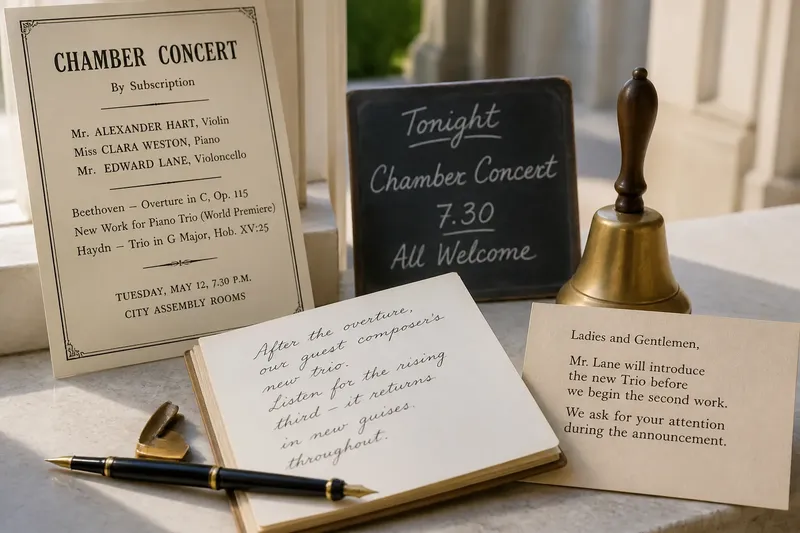
The common mistake is to treat the printed concert programme as a timeless fixture; it obscures the other ways listeners learned what they were hearing. Concert information before printed programmes could come from a notice, a spoken introduction, or the event’s setting, and each source offered a different kind of orientation.
Information in the room
Information did not have to arrive on paper at the door. A musician might announce a title, a host might explain a change of scene, or familiar customs might tell regular listeners what kind of event they had entered. These cues helped people follow the occasion, but they also assumed different levels of familiarity.
When music formed part of a service, ceremony, or theatrical action, its place in the larger event could identify its purpose. The audience might not need a list of every piece because the surrounding activity supplied context. A listener arriving midway, however, could miss that frame.
A spoken announcement could bridge the gap. Naming the next work or offering a brief clue about its character might orient listeners without turning the introduction into a lecture. Too little information could leave newcomers guessing; too much could interrupt the event’s flow.
Notices before performances
A newspaper listing, handbill, or venue notice could name performers and pieces, invite attendance, and indicate the event’s general character. Its main job was to help prospective listeners understand what was being offered. A listing could identify a work without explaining its place in the evening or how to listen for its structure.
That differs from a programme note for an audience already gathered. A notice needs to make the event legible at a glance. A note can help listeners follow an unfamiliar sequence, recognize a change of mood, or consider why two works appear together.
Printed material could also record an occasion through names, titles, and order. A record is not automatically an interpretation, though. A bare list tells readers what was played but may say little about the music’s structure, context, or contrasts.
Notes as listening cues
Printed programmes can orient listeners by identifying a form, describing a text, outlining a dramatic situation, or pointing to a feature worth following. A strong cue gives the ear something manageable to notice, then leaves room for the performance to surprise.
A useful note might answer a practical question: who is speaking, what changes between sections, or why does one work follow another? It need not prescribe what the music means. A listener can carry one detail into the performance and set the page aside.
More information can reduce uncertainty, but dense explanations compete with the event. A note that names every formal detail may turn listening into a search for checkboxes. A short, well-chosen cue is often easier to use.
Choosing a listening cue
What can a notice tell me?
A notice can identify the event, performers, and works before a listener arrives. It may help someone decide to attend, but it does not necessarily explain the order or conventions of the music.
When does a spoken introduction help?
A brief introduction can name a piece, explain a transition, or orient someone who has missed earlier information. It works best when it is audible, specific, and short enough to preserve the event’s flow.
What should a programme note include?
A note can offer a listening handle, such as a recurring idea or a change in the dramatic situation. It should describe something listeners can attend to rather than tell them what emotion to feel.
Should I read while music plays?
Reading continuously divides attention between page and sound. Scan the note beforehand, carry one detail into the performance, and return to the page during a pause if a question remains.
Sharing the information
Organizers can treat orientation as a handoff between sources instead of assigning every explanation to a booklet. A venue listing can establish the event’s basic shape. A spoken welcome can clarify an unusual order. A printed or digital note can offer a listening cue that would be cumbersome to announce.
Give each source a distinct job. Repeating the same paragraph in a listing, welcome, and programme wastes space and attention. The listing might name a pairing, the welcome might explain its place in the sequence, and the note might point to a musical feature connecting the works.
Say a chamber concert pairs a familiar overture with a newer piece that echoes one of its musical gestures. The notice names both works; the host briefly mentions their connection; the note invites listeners to notice how the gesture changes in the later piece. The expected result is a concrete thread listeners can follow, without dictating what they should conclude.
Access matters, too. A spoken cue helps people without a booklet, while a printed or digital note lets listeners revisit details at their own pace. Make essential orientation available in more than one format when practical, without requiring a device or lengthy explanation to follow the event.
Information worth leaving out
Not every piece needs a paragraph of context. If the sequence is clear and the audience knows the event’s conventions, titles and performer names may be enough. Extra explanation becomes noise when it repeats visible information or highlights details that are difficult to hear from the room.
It is not worth trying to pre-interpret every response. Notes that prescribe a single emotional reading narrow listeners’ options and can make disagreement feel like a failure to understand. Point instead to an audible feature, a text, or a relationship within the programme, then leave its meaning open.
For a listener, use programme information selectively: learn the order, check unfamiliar context, and choose one cue to carry into the performance. If the music draws your attention elsewhere, follow it. Concert information before printed programmes came through several channels; that history is a reminder to put essential facts where they are easy to find and treat interpretation as an invitation.